The placebo test that changed my congestion pricing story
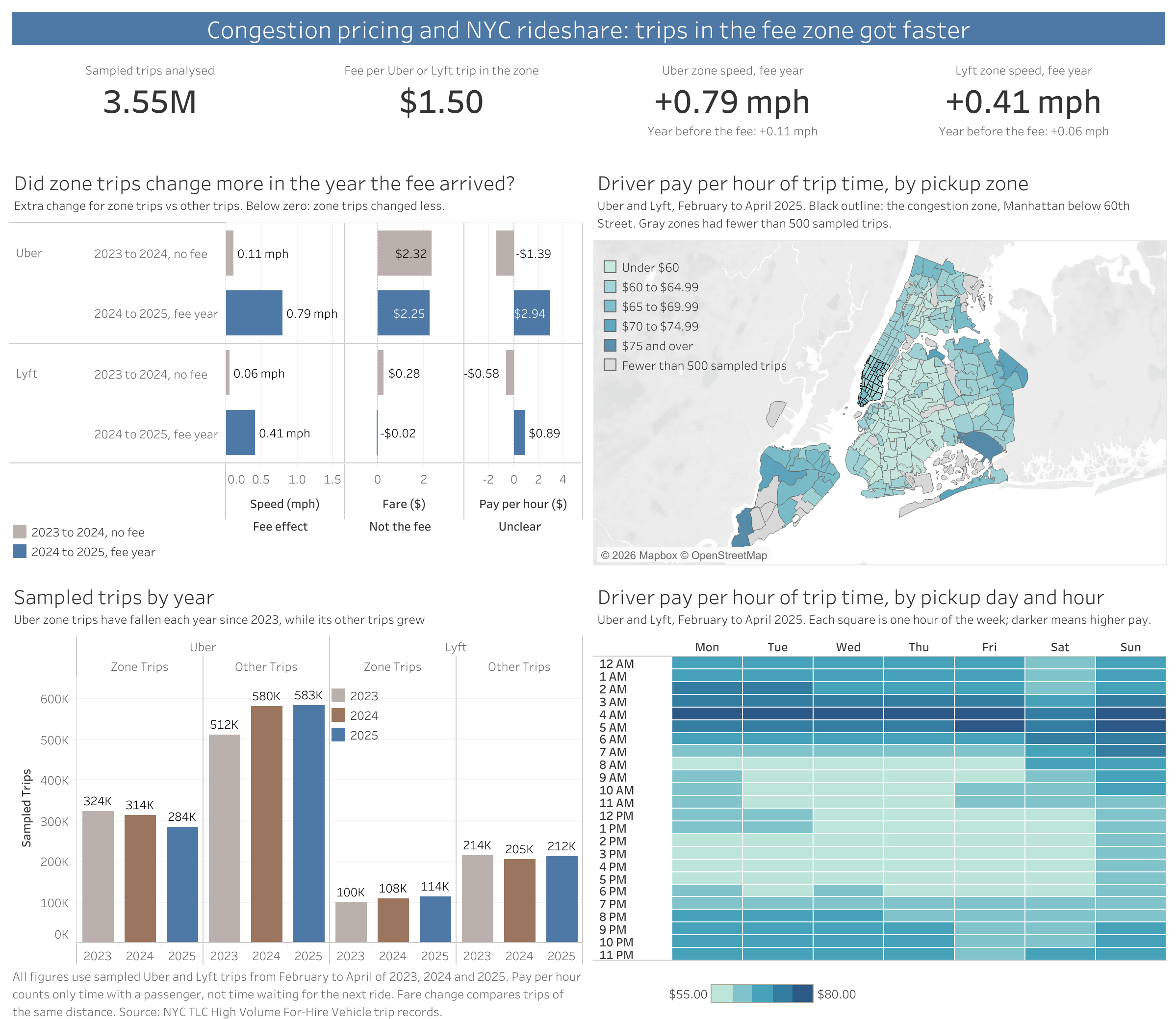
Uber zone fares rose $2.25 more after the fee, but they had risen $2.32 more the year before it existed. On 3.55M trips, only the speed gain survived the check.

Arnold Muzarurwi
Data Analyst candidate

The number that looked like proof
After New York started charging a $1.50 fee on Uber and Lyft trips into and within Manhattan below 60th Street, the average Uber fare for those trips went up by $2.25 more than for trips elsewhere. That is more than the fee itself, which makes a neat headline: congestion pricing made rides cost more.
I almost stopped there. Then I ran the same comparison on a year with no fee at all.
How I set it up
I took a seeded 2% sample of NYC TLC High Volume For-Hire records for February to April of 2023, 2024 and 2025, about 3.55M trips, and loaded them into a MySQL star schema with one trip fact table and company and zone dimensions. I flagged impossible trips instead of deleting them (0.02% of the data) and defined the congestion zone from the data: a taxi zone counts as inside when at least 90% of its internal trips paid the fee, which gave 37 Manhattan zones.
The core method is difference in differences: how much zone trips changed compared with all other trips over the same months, so citywide shifts cancel out. Every gap was tested with a regression, with standard errors clustered by pickup zone.
What the placebo test did
A placebo test asks a simple question: if the policy had nothing to do with it, would I see the same gap anyway? I ran the identical comparison on 2023 versus 2024, a year with no fee.
- Speed: zone trips gained 0.79 mph more than other trips on Uber (0.41 on Lyft), with almost no gap the year before. That effect survives the test.
- Uber fares: zone fares rose $2.25 more at the same distance, but had already risen $2.32 more the year before the fee existed. The increase was a trend, not the fee.
- Lyft fares: riders paid about the fee and little else.
A before-and-after comparison would have credited congestion pricing with Uber's fare rise. The placebo year is what showed it was already happening.
What it means for drivers
Driver pay per hour turned from falling to rising inside the zone (+$2.94 on Uber, +$0.89 on Lyft), which fits trips getting faster. I would not claim the exact size belongs to the policy, since only one pre-fee year was available and other 2025 changes could play a part. Pay per hour also counts only time with a passenger and excludes tips and tolls, so real hourly earnings are lower.
The takeaway
The difference between an analysis and a story is often one extra check. Faster traffic is the effect clearly tied to congestion pricing. The fare rise was a trend the fee inherited. Running the comparison on a year where nothing changed is cheap, and it is what separates the two.
Want to discuss this work? Get in touch.